
When a Texas nurse faces criminal negligence charges, two cases typically move at once: a criminal case in which the State must prove the nurse’s conduct was a gross deviation from the ordinary standard of care, and a Texas Board of Nursing review of the same event that can affect the license no matter how the criminal case ends. A patient harm event alone is not a crime. Whether it rises to criminal negligence depends entirely on the facts, and those facts will be examined in two separate proceedings at the same time.
That parallel pressure is what makes these situations so serious. Your freedom, your license, and your livelihood can all be at stake simultaneously. Here is what Texas law actually says, which charges can apply, and when to bring in an attorney.
What Does Criminal Negligence Mean Under Texas Law?
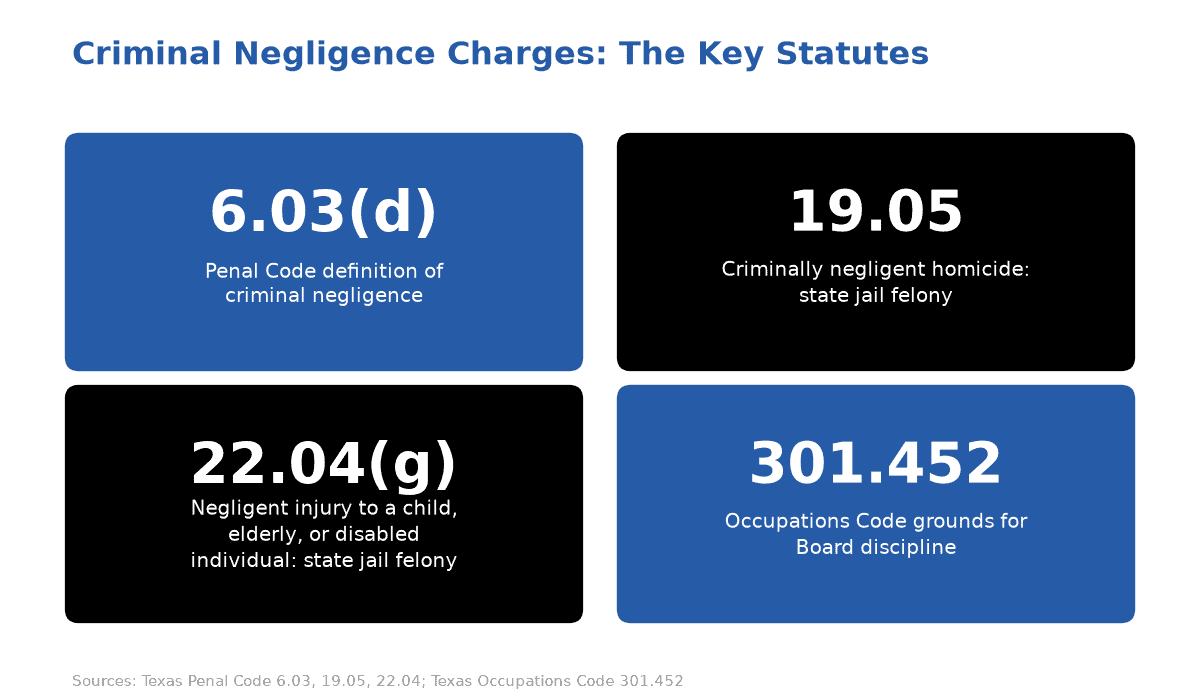
Texas Penal Code 6.03(d) defines criminal negligence as a failure to perceive a substantial and unjustifiable risk, where that failure is a gross deviation from the standard of care that an ordinary person would exercise under the same circumstances. Note the word perceive: the standard is not that you acted recklessly or intended harm. The State’s theory is that you should have recognized the risk and did not.
That definition draws a specific legal line, and understanding where it falls matters.
Criminal Negligence Versus an Ordinary Mistake
An ordinary mistake is an error that a careful, competent person could make under pressure. Clinical work involves complexity, incomplete information, and time constraints. A bad outcome does not automatically mean someone failed to perceive an obvious risk.
Criminal negligence requires something more: a failure so significant that it represents a gross deviation from what any ordinary person would do in that situation. A medication calculation error, a documentation lapse, or a misjudgment about a patient’s status may be grounds for a Texas Board of Nursing investigation without ever approaching the criminal threshold. The line between the two is not always clear, which is exactly why the facts of each case control the outcome.
Why the Facts of Each Case Decide It
No blog post can tell you whether specific conduct meets the criminal negligence standard, because that determination is made by prosecutors, grand juries, and courts on the specific facts presented. Two patient harm events that look similar on the surface can land in very different places legally depending on what the nurse knew, what resources were available, what supervision existed, and what the record shows. Nothing in this post predicts how any particular case will go.
Which Criminal Negligence Charges Can a Nurse Face in Texas?
Two Texas statutes can apply when a nurse is criminally charged after a patient harm event. Both are state jail felonies at the negligence level. Prosecutors make charging decisions based on the facts, and which charge applies, if either does, varies by case.
Criminally Negligent Homicide
Texas Penal Code 19.05 covers criminally negligent homicide: causing the death of an individual by criminal negligence. This is a state jail felony. When a patient dies and a prosecutor believes the nurse’s conduct meets the 6.03(d) standard, this is the charge that applies.
Injury to a Child, Elderly Individual, or Disabled Individual
Texas Penal Code 22.04 covers injury to a child, an elderly individual, or a disabled individual. The offense can be committed with criminal negligence, and under 22.04(g) it is a state jail felony at that level. Under 22.04(d), a person assumes care, custody, or control when their conduct, words, or course of action causes a reasonable person to conclude they have accepted responsibility for the patient’s protection, food, shelter, or medical care.
Why the Charge Depends on the Facts
Prosecutors look at the identity of the patient, the nature of the harm, and the evidence of what the nurse knew or failed to perceive. The same conduct can be charged differently depending on whether the patient died, whether the patient was in a protected class under 22.04, and what the full record shows. A nurse criminal defense attorney evaluates the specific facts before advising on how a charge is likely to be framed.
How Criminal Negligence Charges and a TBON Investigation Run Side by Side
The criminal case and the Texas Board of Nursing review are separate proceedings governed by separate standards. The criminal case requires proof beyond a reasonable doubt. The Board’s disciplinary review applies its own standard under the Nursing Practice Act.
Two Cases, Two Different Standards
Under Texas Occupations Code 301.452, the Board has fourteen grounds for disciplinary action. Two are directly relevant here: subsection (b)(10), which covers unprofessional conduct likely to deceive, defraud, or injure patients or the public, and subsection (b)(14), which covers failure to provide adequate patient care or conform to acceptable standards of nursing practice. The Board does not need a criminal conviction to act. It can investigate and discipline based on its own review of the same event, and it does not wait for the criminal case to conclude.
When the Board decides on a sanction, it weighs factors such as actual or potential harm to patients, the seriousness of the violation, and whether the nurse was truthful. Those factors come from Board rules that carry out the Nursing Practice Act.
Why What You Say in One Can Reach the Other
This is the most practical reason to have both sides of the matter handled together. A statement made to a hospital risk manager, a police investigator, or a Board investigator does not stay in one lane. What you say in one proceeding can be reviewed in the other, and an explanation that seems harmless in a workplace meeting can carry different weight in a criminal case. The two proceedings affect each other in ways that are not always obvious in the moment.
When Should a Nurse Hire an Attorney?
Earlier is better. The first statement a nurse gives is often the one that matters most in both proceedings. Here are the moments that signal it is time to act:
- Police contact: A police officer or investigator asks to speak with you about a patient incident, even informally.
- A request for a statement: Anyone, including hospital administration, a risk manager, or law enforcement, asks for a written or recorded statement.
- A letter from the Board: The Texas Board of Nursing contacts you about a complaint or investigation tied to a patient harm event.
- An arrest or charge: You are arrested or formally charged with any offense related to patient care.
Signs the Matter Has Become Criminal
Investigators do not always announce that a case has turned criminal. If you are being asked about a patient’s death or serious injury, if law enforcement is involved at any level, or if you have been told you are the subject of an investigation rather than a witness, those are signals the situation has moved beyond a workplace review.
Before You Give a Statement
You do not have to explain yourself on the spot. Asking to speak with an attorney before answering questions is not an admission of anything. It gives your attorney the chance to learn the facts and weigh the risks in both proceedings before anything is on the record, and your attorney can handle contact with investigators and the Board on your behalf.
Schedule a Consultation at Texas Nursing Lawyers in Dallas
Texas Nursing Lawyers handles both sides of what nurses face after a patient harm event: nurse criminal defense and Texas Board of Nursing license defense, under one roof. Attorney Buck Johnson served as a prosecutor with the Dallas County District Attorney’s office from 2005 until 2009, prosecuting cases ranging from DWI to capital murder, and now defends. Attorney Deborah Goodall has practiced criminal law since 1984 and focuses on representing nurses before the Board.
If you are a Texas nurse dealing with a criminal investigation, criminal negligence charges, or a Board complaint related to a patient incident, contact Texas Nursing Lawyers to schedule a confidential consultation. The earlier experienced counsel is involved on both tracks, the more room there is to protect your rights in each one.