
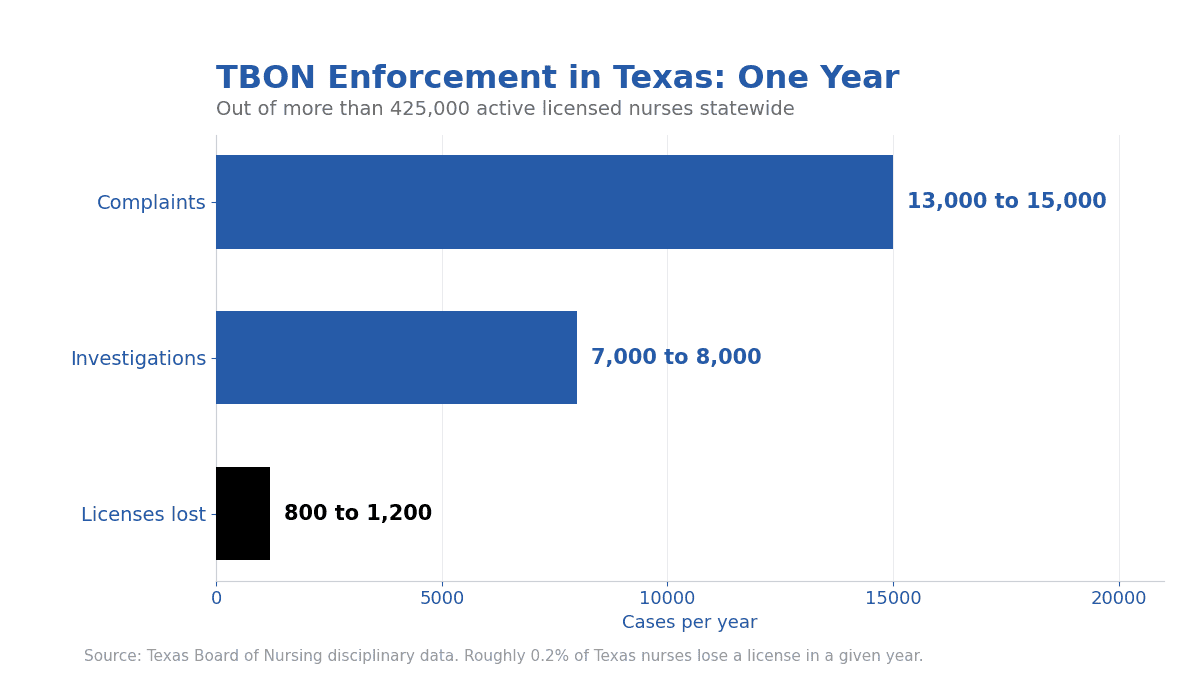
Texas Board of Nursing (TBON) data shows that roughly 800 to 1,200 Texas nurses lose their license each year through revocation or voluntary surrender, about 0.2% of the more than 425,000 active licensed nurses in the state. The Board takes thousands more disciplinary actions every year, but most do not end in license loss. The pattern is clear: when nurses lose their license, it is almost always for a small set of recurring reasons, and almost always after a small set of avoidable mistakes.
Knowing the numbers is not just trivia. It tells you where TBON enforcement actually focuses, which behaviors carry the most career risk, and where the highest-leverage decisions get made. The Board’s public disciplinary actions are posted monthly, and the patterns are remarkably consistent year over year.
Here’s what the data actually says, and what every Texas nurse can do to keep their name off that list.
Texas Board of Nursing Enforcement by the Numbers
Texas has more than 425,000 active licensed nurses (RNs, LVNs, and APRNs combined), making it one of the largest nursing populations in the country. Within that population:
- The Board receives roughly 13,000 to 15,000 complaints per year against Texas nurses.
- About 7,000 to 8,000 complaints per year result in some form of investigation.
- Disciplinary actions, warnings, fines, monitoring, suspensions, and revocations, number in the low thousands annually.
- License revocations and voluntary surrenders together typically run between 800 and 1,200 per year.
In percentage terms, that is roughly 0.2% of all Texas nurses losing their license in any given year. Small slice of the workforce, big number when you measure it in careers ended.
The Top Reasons Texas Nurses Lose Their License
TBON revocation patterns cluster around a small number of conduct categories. Across multiple reporting years, the same five reasons appear at the top of the disciplinary list:
- Substance use and impairment: Diversion of controlled substances, working under the influence, and failure to comply with the Texas Peer Assistance Program for Nurses (TPAPN) drive a large share of license losses. Drug-related cases are the single largest enforcement category in most reporting periods.
- Criminal conduct: Felonies and serious misdemeanors, particularly those involving violence, theft, fraud, or repeat patterns, produce a steady stream of revocations. A single criminal conviction rarely costs a license on its own. A pattern, an aggravating fact, or non-disclosure usually does.
- Patient-care misconduct: Documented patient neglect, abuse, abandonment, and significant medication errors that harm patients trigger some of the most serious disciplinary outcomes.
- Practicing on a delinquent or invalid license: Nurses who continue to practice after their license has lapsed, been suspended, or been restricted face escalating discipline. This category accounts for a surprising number of revocations every year, usually because the nurse did not realize the renewal had not gone through, or assumed the restriction did not apply to their setting.
- Failure to comply with prior Board orders: A nurse already on probation, monitoring, or in an Agreed Order who violates the terms is often referred straight for revocation. Compliance failure is one of the fastest paths from a manageable case to license loss.
Where Most Cases Actually Resolve
The headline number, license revocation, is the rarest TBON outcome. Most cases close at one of several earlier stages:
- Dismissal: Many complaints close without action because they do not allege a violation of the Nursing Practice Act or because the evidence does not support discipline.
- Confidential remediation: For minor issues, the Board may direct the nurse to complete continuing education or other corrective steps without imposing public discipline.
- Warning or reprimand: A documented but non-restrictive sanction.
- Fine: Often paired with a warning or remedial education.
- Agreed Order with stipulations: A negotiated settlement that may include practice restrictions, monitoring, or supervised practice. This is the most common outcome for serious cases that do not warrant suspension.
The path from “complaint received” to “license revoked” is long. At every stage, the nurse has meaningful opportunities to influence the outcome, and most of those opportunities open up early in the process.
Risk Patterns That Lead to License Loss
The data reveals clear patterns. Nurses who lose their license tend to share several characteristics:
- A delayed or missing response to the initial Board investigation letter
- Unaddressed substance use issues, especially when not voluntarily disclosed
- Multiple prior incidents (criminal, employment, or Board-related)
- Non-compliance with TPAPN or a prior Agreed Order
- Practicing under restrictions without adhering to them
The opposite is also true. Nurses who keep their licenses through serious cases tend to engage early, hire a nurse license defense attorney before the first response, complete proactive treatment when relevant, and maintain a consistent professional record during the case.
What This Means in Practice
If your case shares one or two of the risk patterns above, the trajectory is not fixed. Engaging counsel and addressing the underlying issue, even partway into the investigation, can change the outcome. The cases that end in revocation almost always show several risk patterns stacked together, ignored over time. The cases that end favorably almost always show early intervention.
Protect Your Nursing License Before It Becomes a Statistic
The TBON numbers make one thing clear: most Texas nurses who face a complaint never lose their license, but the ones who do almost always share avoidable risk patterns. The earliest decisions in a case (whether to respond, what to disclose, whether to seek treatment, whether to engage counsel) are the decisions that drive the final outcome.
If you are a Texas nurse facing a TBON complaint, an investigation, or a disciplinary letter, contact Texas Nursing Lawyers today for a free consultation. Attorneys Buck Johnson and Deborah Goodall have over 50 years of combined experience defending Texas nurses before the Board, and they can help you protect your nursing license and your career before the case progresses.