
A medication error nursing license investigation in Texas does not automatically end a nurse’s career, but it can. Whether the Texas Board of Nursing takes disciplinary action depends on the severity of harm, whether a pattern of errors exists, and what the nurse did after the incident. Under 22 Texas Administrative Code 217.16, the Board distinguishes conduct that qualifies as a minor incident from conduct that must be reported and formally investigated. A single accidental error with no patient harm and no documentation problems often resolves through remediation, not a Board complaint. Cases that lead to suspension or revocation typically involve falsification of records, repeated errors, or actual serious patient harm.
Understanding where your situation falls on that spectrum, and what your rights are at each stage, is the most important step you can take right now.
What Makes a Medication Error a Minor Incident Under Texas Board of Nursing Rules?
Not every medication error triggers a Board complaint. Texas law creates a specific category called a minor incident, and whether an error qualifies changes how it is handled.
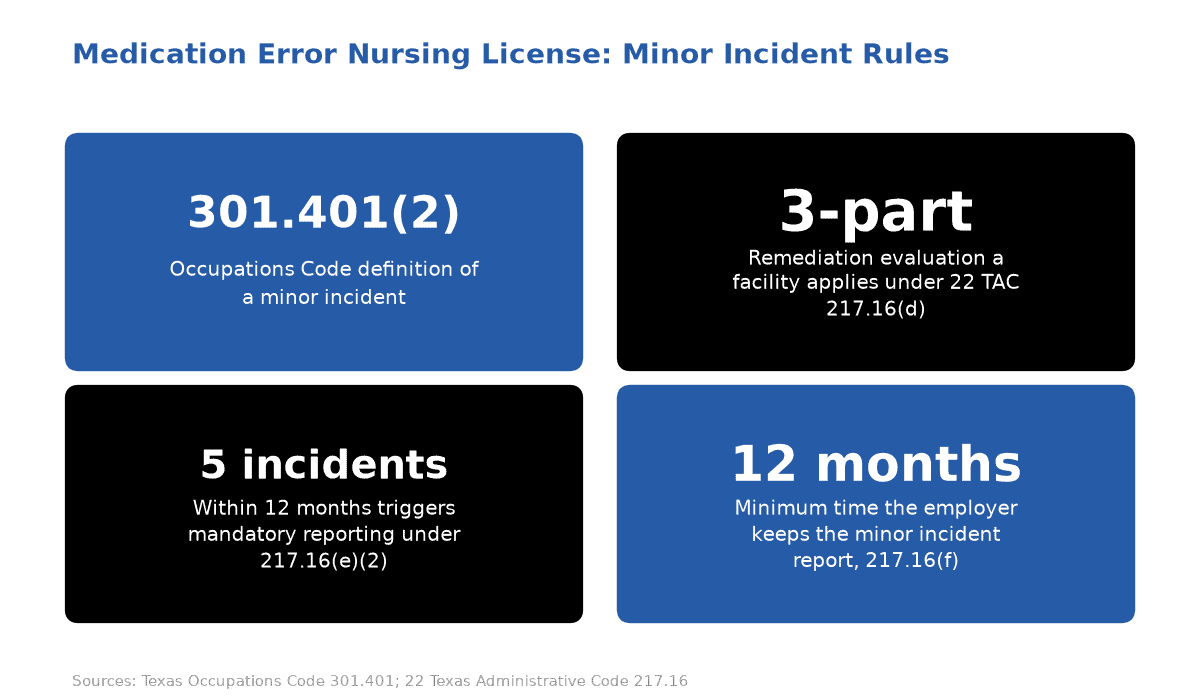
Under Texas Occupations Code 301.401(2), a minor incident is conduct that may violate the Nursing Practice Act or a Board rule but does not indicate the nurse’s continued practice poses a risk of harm to patients or others.
The Three-Part Remediation Evaluation
When a facility reviews an error under 22 TAC 217.16(d), it applies a three-part evaluation:
- Whether the error reflects a knowledge or judgment deficit in the nurse
- Whether remediation can reasonably address that deficit
- Whether factors outside the nurse’s control contributed to the error
If remediation is appropriate and the incident does not indicate ongoing risk, the facility can handle it internally without a Board report.
When the Count Matters
Five minor incidents within a 12-month period change the picture. Under 217.16(e)(2), that pattern triggers mandatory reporting, either to nursing peer review or directly to the Board. The employer must also prepare, monitor and maintain a minor incident report for at least 12 months under 217.16(f).
A single charting slip or a wrong-dose catch intercepted before reaching the patient may stay internal if the incident is properly classified and remediation is appropriate. The classification decision belongs to the facility, and the Board is not bound by it if a complaint arrives from another source.
When Does a Medication Error Have to Be Reported to the Texas Board of Nursing?
The minor incident pathway has clear limits. Under 22 TAC 217.16(h), certain categories of conduct must be reported regardless of how a facility characterizes the error:
- Conduct that disregards a substantial risk of significant harm to patients
- An error that contributed to a patient’s death or serious injury
- Conduct demonstrating the nurse lacks the knowledge, judgment or skill for safe continued practice
When those thresholds are met, peer review is typically the first formal step under Texas Occupations Code Chapter 303 and 22 TAC 217.19. When impairment is a factor, the Texas Peer Assistance Program for Nurses (TPAPN) under 301.410 may be available as an alternative pathway.
Intentionally misclassifying an incident to avoid reporting may itself violate the mandatory reporting statute, per 217.16(d)(4). A facility’s decision not to report does not protect the nurse if the Board receives a complaint from a patient, a coworker, or another source. A nurse who assumed internal resolution was final can be surprised when a complaint arrives later.
If a letter from the Board has already arrived, what you do after receiving a TBON letter is your most urgent next step.
What Does the Texas Board of Nursing Investigate After a Medication Error?
When a complaint reaches the Board, investigators do not simply look at whether an error happened. The Texas Board of Nursing investigations process examines a broader set of questions about the nurse’s conduct before, during and after the incident.
The Standards That Govern the Review
The Board’s primary disciplinary ground in medication error cases is Texas Occupations Code 301.452(b)(14): failure to conform to acceptable standards of nursing practice. The documentation standard under 22 TAC 217.11(1)(D) requires accurate and complete documentation of medications administered and client responses, so the Board’s review of charting is central to every case.
Why a Cover-Up Changes Everything
Falsifying client documentation is unprofessional conduct under 22 TAC 217.12(6)(A), and improper management of client records is addressed in 217.12(1)(C). The Board treats falsification as a more serious violation than the underlying error because it directly implicates the nurse’s trustworthiness and satisfies grounds for discipline under 301.452(b)(10).
How Sanctions Are Set
The factors the Board and State Office of Administrative Hearings (SOAH) weigh under 22 TAC 213.33 include:
- Actual or potential harm to patients
- Prior disciplinary history
- The nurse’s demonstrated truthfulness during the investigation
- Seriousness of the violation
- The Board’s Disciplinary Matrix
An attorney reviewing this stage can assess the nurse’s documentation, the facility’s incident records and the complaint before the nurse submits a written response, which becomes part of the formal record.
What Outcomes Can a Nurse Expect From a TBON Medication Error Review?
Texas Board of Nursing disciplinary outcomes exist on a spectrum. What a nurse facing a medication error nursing license review can realistically expect is a range of possibilities:
- Dismissal or minor incident resolution when the facts support the classification and remediation was appropriate
- Remediation order or a warning when a knowledge or judgment deficit is identified but the nurse’s practice does not pose an ongoing public risk
- Agreed order with stipulations, which is a public record under Texas Occupations Code 301.463(c); the nurse has the right to negotiate its terms before signing
- Formal hearing before a SOAH administrative law judge under 301.459 when the nurse contests the charges or the parties cannot reach agreed terms
- Suspension or revocation in cases involving repeated errors, serious patient harm, falsification or conduct meeting the grounds under 301.452(b)(10) or (b)(14)
Understanding the types of nursing orders helps a nurse recognize what an agreed order actually commits them to before signing anything.
How Does Falsifying Records After a Medication Error Make Things Worse?
When a nurse makes an error and then alters the record to conceal it, the Board is no longer investigating only a practice lapse. It is investigating a character issue, and that changes the calculus on every sanction factor.
The governing standard is 22 TAC 217.12(6)(A), which identifies falsifying client documentation as unprofessional conduct. Section 217.12(1)(C) separately addresses improper management of client records. Both provisions feed directly into the 301.452(b)(10) ground for discipline: conduct the Board finds likely to deceive or injure patients.
Under 22 TAC 217.11(1)(D), nurses are required to accurately and completely document medications administered and patient responses. When investigators review the chart, they examine the timing of entries, any amendments and the full audit trail. An attorney examining the same record on the nurse’s behalf is doing exactly what the Board’s investigators will do, and identifying problems before the nurse responds gives the defense the clearest possible picture of where the risk lies.
When Should a Texas Nurse Contact a License Defense Attorney After a Medication Error?
The answer is almost always: sooner than you think. Here are the moments when having nurse license defense counsel is most important:
- Before responding to a Board complaint letter. The nurse’s first written response shapes the evidentiary record and can close off options that would otherwise be available.
- Before the informal settlement conference under 22 TAC 213.20. The rule gives the nurse the right to be represented by an attorney of record; attending without counsel means answering the Board’s staff questions on the record without legal guidance.
- When a facility investigation is running at the same time as a Board inquiry. An attorney handles the license side; employment consequences are a separate matter governed by different standards.
- When the nurse is unsure whether the incident was properly classified as a minor incident or whether reporting obligations were triggered.
A confidential consultation does not commit a nurse to any particular course of action. It gives the nurse a clear picture of where the process stands and what the options are.
Schedule a Consultation at Texas Nursing Lawyers in Dallas
If you are a Texas nurse facing a Board complaint or investigation after a medication error, the time to get information is now, before you submit anything in writing. Texas Nursing Lawyers represents RNs, LVNs and APRNs across Texas in TBON disciplinary proceedings. Deborah Goodall and Buck Johnson understand the administrative law process that governs these cases and can review your situation confidentially. Contact Texas Nursing Lawyers to schedule a consultation and protect the license you have worked to build.